
AI in FP&A: What The FP&A Guy Thinks (And Why CFOs Still Won't Let It Touch the Budget)
By Charlie Liu ·

There is a CFO out there using AI for variance commentary, narrative generation, and reporting. But when the conversation turns to letting it update the budget model, the answer is immediate: absolutely not.
Paul Barnhurst, founder of The FP&A Guy and host of three podcasts, sat down with Charlie Liu on Making Cents with Charlie to discuss where that fear comes from, whether it is rational, and what the current state of AI in FP&A actually looks like. Watch the full episode here

The CFO Who Won't Let AI Touch the Numbers
Paul recently encountered a planning tool vendor post on LinkedIn celebrating a CFO who was using their AI features for variance commentary and reporting. But the CFO had drawn a firm line: AI could not touch the budget itself.
"The CFO was saying, I won't let it touch my numbers. I don't trust that it will be right," Paul explained. What made this interesting was the vendor's response: the underlying math in the model was deterministic. The AI was calling other tools to do the calculations, not doing arithmetic itself. The CFO's concern was technically already resolved.
"An LLM doesn't need to do any math if you don't want it to. An agent can have other tools doing the math deterministically," Paul said. But the CFO still wasn't comfortable.
This reflects a broader pattern. CFOs are historically cautious AI adopters, citing concerns about data accuracy, explainability, and the risk of unreliable outputs in financial decision-making. The tools have moved further than the confidence has. The question is not whether AI can handle FP&A math, it is whether finance leaders have seen enough to trust the architecture.
The Planning Tool Dilemma Has Not Been Solved
One of the most consistent themes in the conversation was the tension between structure and flexibility in planning tools, and why Excel keeps winning despite decades of attempts to replace it.
"As soon as a tool can't handle a use case, and it's going to happen, the default is to go back to the tool everybody's been trained on, that virtually costs zero, and they'll do it in short order," Paul said.
The structural trap is real: every planning tool trades flexibility for governance. The more structured the tool, the easier it is to automate and audit. The less flexible it is when the business model changes, when an acquisition lands, or when a new revenue line does not fit the original architecture.
The exception tends to be upper mid-market and enterprise. At scale, the pain of staying in Excel outweighs the loss of flexibility. For smaller and faster-moving companies, that calculus often still favors Excel by elimination. A practical wrinkle both Paul and Charlie flagged: some of the most sophisticated finance teams at large firms have arrived at a hybrid approach, building all their logic in Excel and using a planning tool purely as a structured data store.
The Context Window Problem Nobody's Talking About
One technical point stood out that rarely surfaces in mainstream FP&A discussions: the token compression problem.
When AI tools work on complex Excel models, there is a fundamental constraint. Reading every cell in a large file line by line consumes enormous context. Paul pointed to reports that this is part of why Microsoft Copilot for Excel has underperformed expectations: the model is processing the entire file rather than compressing intelligently.
"If I see this formula in the first three columns, I should assume it's the same for the whole row. I know the logic, and I just need to pass the logic to the LLM instead of giving it 5,000 columns," Paul said. Some third-party tools have built proprietary compression layers to address exactly this. Most have not.
For finance leaders evaluating AI tools for complex FP&A work, this is the right technical question to ask: how does the tool compress and interpret model logic, rather than just reading raw data?
The Skills That Actually Matter Now
Ask Paul what skill matters most in FP&A today and the answer has started to shift. For years, the top answers were Excel and financial modeling. Recently, a different answer has been rising: systems thinking and data modeling.
"They're all trying to get the most out of AI," Paul noted. "And so it's interesting to watch what they consider most important. Before, that was hardly listed."
His recommendation for finance leaders building teams, and for anyone in FP&A trying to stay relevant: add a genuine data background. Not just a passing familiarity with SQL, but an understanding of how data flows, how systems connect, and how to design requirements before touching a tool. On the soft skills side, the most consistent answer from CFOs and senior finance leaders is empathy: the ability to place yourself inside sales, marketing, or operations to understand what the numbers mean to the people living them.
The dark horse skill: the ability to make things simple. Fewer people can look at complex logic and find the clean table lookup that replaces it. That skill becomes more valuable as AI handles more of the mechanical modeling work, because the judgment layer is what remains.
The Model Is Not the Plan
The deepest insight in the conversation may have been the simplest: most FP&A teams overinvest in the modeling phase and underinvest in the planning phase.
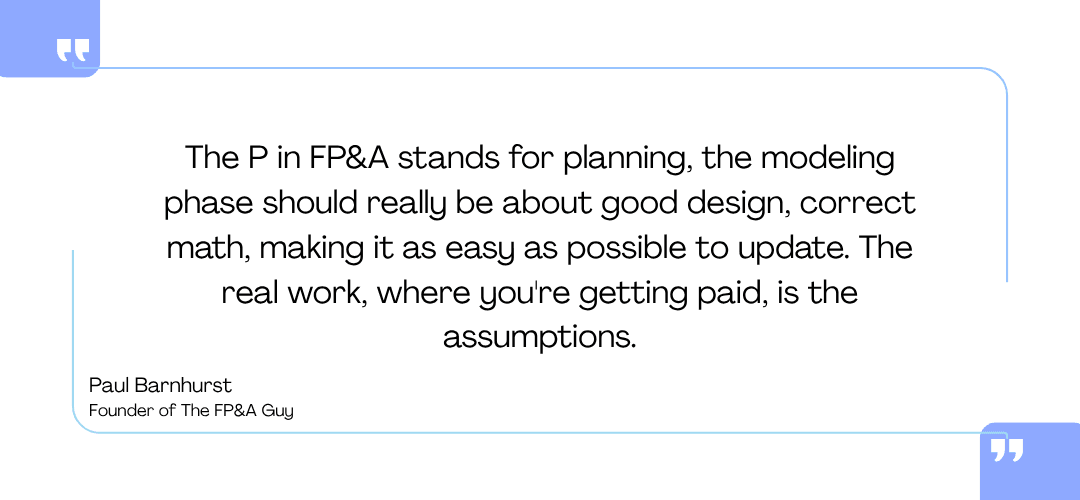
All models are wrong. A model with technically perfect math built on weak assumptions is less useful than a model with a small arithmetic error built on a deep understanding of the business. The planning phase, where you actually think through strategy, pressure-test drivers, and understand the operations, is where the accuracy is won or lost.
This is where AI is actually a strong fit. The 2026 data shows that CFOs getting real returns from AI started with high-impact, lower-complexity use cases: automated variance analysis, anomaly detection, and baseline forecast generation. The irony is that the modeling phase is where most teams try to apply AI first, because it is the most visible and the most tedious. The real value is elsewhere.
For CFOs thinking about where AI adds value in the finance function: the narrative work, the assumption documentation, the variance explanations, and the scenario planning conversations are the right starting points, not the model architecture.
The Takeaway
Paul Barnhurst has spent more than a decade inside corporate finance and the last four years building one of the most respected independent voices in the FP&A space. His read is not optimistic on every dimension. He believes over-reliance on AI will make society measurably less capable if current trends continue. But his practical guidance for finance leaders is clear.
Understand the trust gap before dismissing it. Ask the right technical questions about the tools you are evaluating. Build teams with genuine data fluency alongside financial modeling skill. And invest in the planning phase, where the real judgment lives.
Ready to Build the Finance Infrastructure That Supports This Kind of Thinking?
The gap between a technically correct model and a plan leadership actually trusts is usually a design problem, not a data problem. If your team is spending more time maintaining models than pressure-testing assumptions, that is worth examining.
Talk to our team to see how this works in practice.
Last updated