
What 50 Years of Hotel Budgeting Teaches Finance Teams
By Charlie Liu ·

Picture a hotel finance office in the late 1970s. The president walks in with a simple question: "What happens to labor costs if we change our occupancy assumption by 5%?"
To answer, William (now VP of Finance at Trump Hotels) had to pull out a physical, 13-column paper ledger, reach for his eraser, and manually recalculate every single cell, row by row, across every department. One column for the account. Twelve for each month. One for the annual total. "You can imagine what that looked like," William recalls.
Over a nearly five-decade career in hospitality finance, William has witnessed every major revolution in Financial Planning and Analysis firsthand: from paper ledger sheets to Lotus 1-2-3, from single-tab Excel workbooks to modern cloud platforms. His journey is not just a history of technology. It is a masterclass in how to scale a finance function without breaking it, and when to know the infrastructure you have is no longer the infrastructure you need.
From Paper to Pixels (and the Fragility of Excel)
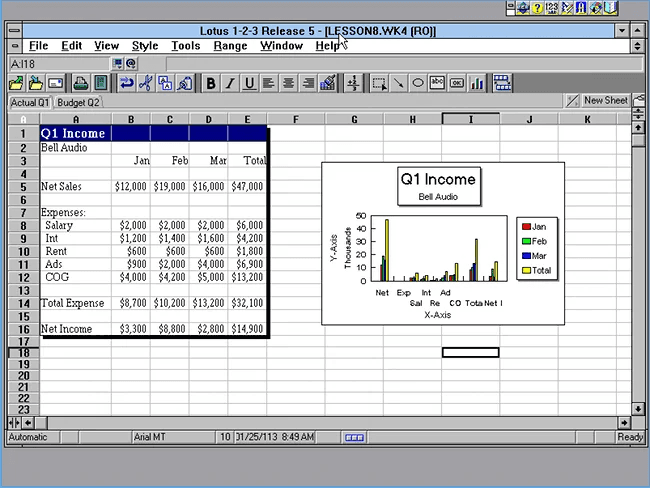
When IBM PCs arrived around 1980 running Lotus 1-2-3, the reaction in finance departments was immediate. Hitting "F9" to recalculate a spreadsheet took up to an hour, but that was still a revolution. "We would do that for our lunch break, come back, and it would be done," William says. "That beat working on manual paper."
The early spreadsheets did not even have tabs. Every department lived on a single continuous page. But as performance improved and Excel matured, the tool's potential grew with it.
Budgeting granularity exploded. Revenue was now projected day by day. Labor costs were tied directly to occupancy rates for each department. Food and beverage was split not just by category, but by individual meal period, breakfast, lunch, brunch, dinner, and in some cases late night.
"The increased level of granularity gave us a more efficient and reliable budget," William explains. "And that, with the aid of a computer, helped us develop forecasting in a way that became genuinely reliable."
But that computing power came with a structural vulnerability. As models grew more complex, formula errors became endemic. An edit would be made, and some formulas would update while others would not. Broken links propagated silently through the model, and the damage was not always visible until leadership was already looking at the wrong number.
"Top management started losing confidence in Excel as a budgeting and forecasting tool," William recalls. That erosion of trust is the moment most finance leaders recognize. It is not the errors themselves that are the real cost, it is what happens to decision-making when leadership no longer believes the model.
The Infrastructure Pivot: Ten Years of Patience
For years, William's team cycled through the classic finance infrastructure loop. Excel became too unwieldy. Dedicated corporate planning software felt too rigid and too foreign. The team would adopt something new, push back against it, and eventually retreat to the familiar mess of spreadsheets.
The difference this time was that William was not reactive. He had identified Vena as a potential solution nearly a decade before he implemented it.
That patience was strategic, not passive. When the Trump Hotels portfolio grew to six properties and managing consolidated FP&A across all of them on Excel became a governance problem, version control failures, broken formula chains, no one version of the numbers everyone trusted, William already knew exactly where to go.
The Vena implementation succeeded where previous transitions had stalled because the platform did not ask the team to abandon what they already knew. Vena embeds a centralized, auditable database directly inside the Microsoft Excel interface. For a finance team that had spent decades in spreadsheets, the learning curve was minimal. The governance upgrade was immediate. The simultaneous rollout across all six properties went smoothly, something William credits in part to MCC's hands-on support throughout the implementation process.
Every Revolution Follows the Same Pattern
William has now lived through enough technology shifts to see the pattern clearly.
In 1995, the internet transformed hospitality overnight. Booking engines, Expedia, and Hotels.com took reservations out of travel agents' hands and put them directly in guests' browsers. That shift generated something the industry had never had before: forward-looking booking data at scale. Actual reservations, both corporate and leisure, sitting on the books weeks and months in advance.
"An efficient system leads to incremental revenues and incremental bottom line," William says. "Every part of the cycle becomes more efficient. The revenue grows, the business grows, and that ultimately leads to new demand, new development, and new jobs."
Generative AI and real-time data tools are the next version of that same shift. The paradigm changes, but the underlying question stays constant: does your current infrastructure allow you to operate at the scale you are heading toward? William has learned to answer that question before the scale arrives, not after.
That same discipline applied during the most severe test the hospitality industry has faced in modern history. When the pandemic shuttered travel globally, the finance teams with reliable, flexible planning infrastructure were the ones that could model scenarios quickly, stress-test assumptions, and preserve whatever runway they had. "Any form of distress provides a situation that we can always manage better having had the experience," William reflects. The finance function that had been an afterthought became the center of every serious recovery conversation.
What Five Decades in the Industry Teach You
There is one more lesson from William's career that does not fit neatly into a technology narrative, but matters just as much for anyone building a long-term career in finance.
"Once a candidate enters our industry and grows within our industry, they seldomly leave," William says. "And if they do leave, they ultimately come back, because it is fun, it's dynamic, and the opportunities for advancement are great."
Hospitality finance is a small world. William has been in different countries across the globe and crossed paths with colleagues from earlier chapters of his career on Fifth Avenue in New York. That interconnectedness means reputation travels as far as ambition does.
His advice to younger finance professionals is straightforward: put in the hours, think long-term, and do not burn bridges in an industry where everyone eventually runs into everyone. The skills, forecasting, modeling, infrastructure thinking, compound over time the same way a well-built financial model does.
The Takeaway
From 13-column paper ledgers to automated multi-property forecasting across six hotels, the defining question in William's career has always been the same: does your current tool allow you to operate at the scale you need?
The answer to that question requires honesty about where the infrastructure is already fracturing, not where it might fracture in three years. The finance leaders who upgrade before they are drowning are the ones who stay in control of the narrative when conditions shift.
If your planning process has not kept pace with your portfolio, MCC can help you close that gap.
Frequently Asked Questions
What is Vena and why is it used in hospitality finance?
Vena is a Complete Planning platform that embeds enterprise-grade financial governance inside Microsoft Excel. For hospitality finance teams, it eliminates the version control failures and formula errors that come with multi-property Excel models while keeping the familiar interface finance teams already know. It is particularly valuable when managing consolidated FP&A across multiple hotel properties simultaneously.
What are the biggest FP&A challenges in hotel and hospitality finance?
The core challenge is scale. Managing budgets for a single property in Excel is workable. Managing consolidated forecasting across multiple properties, with day-by-day revenue projections, labor tied to occupancy, and F&B broken out by meal period, creates governance complexity that spreadsheets cannot reliably handle. Formula errors erode leadership trust, and version control failures mean decisions get made on outdated numbers.
How long does a Vena implementation take for a multi-property hospitality company?
Timeline varies based on portfolio size and process complexity. William's team successfully implemented Vena across six Trump Hotels properties. The implementation succeeded in part because the platform's Excel-native interface kept training time minimal and because MCC provided hands-on support throughout the rollout.
Why do companies wait too long to upgrade their financial infrastructure?
Most companies wait because the existing system still works, just not at the scale they need. There is no single breaking point, only a gradual erosion of trust in the numbers. William's approach was different: he identified Vena as a future solution nearly a decade before implementing it, then moved decisively when the portfolio reached the scale that demanded it. Learn how to scale smart with MCC here
Last updated